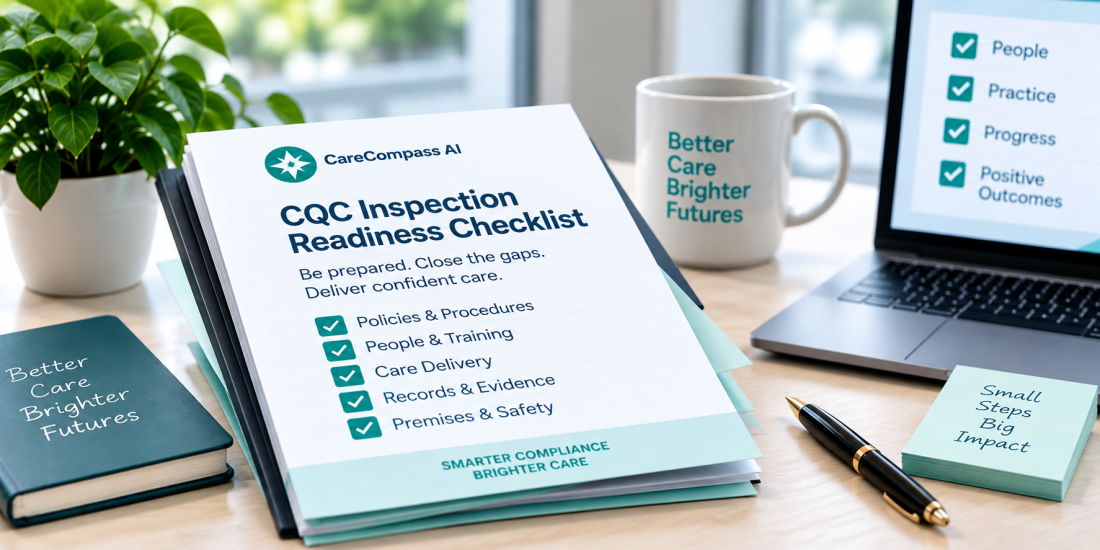
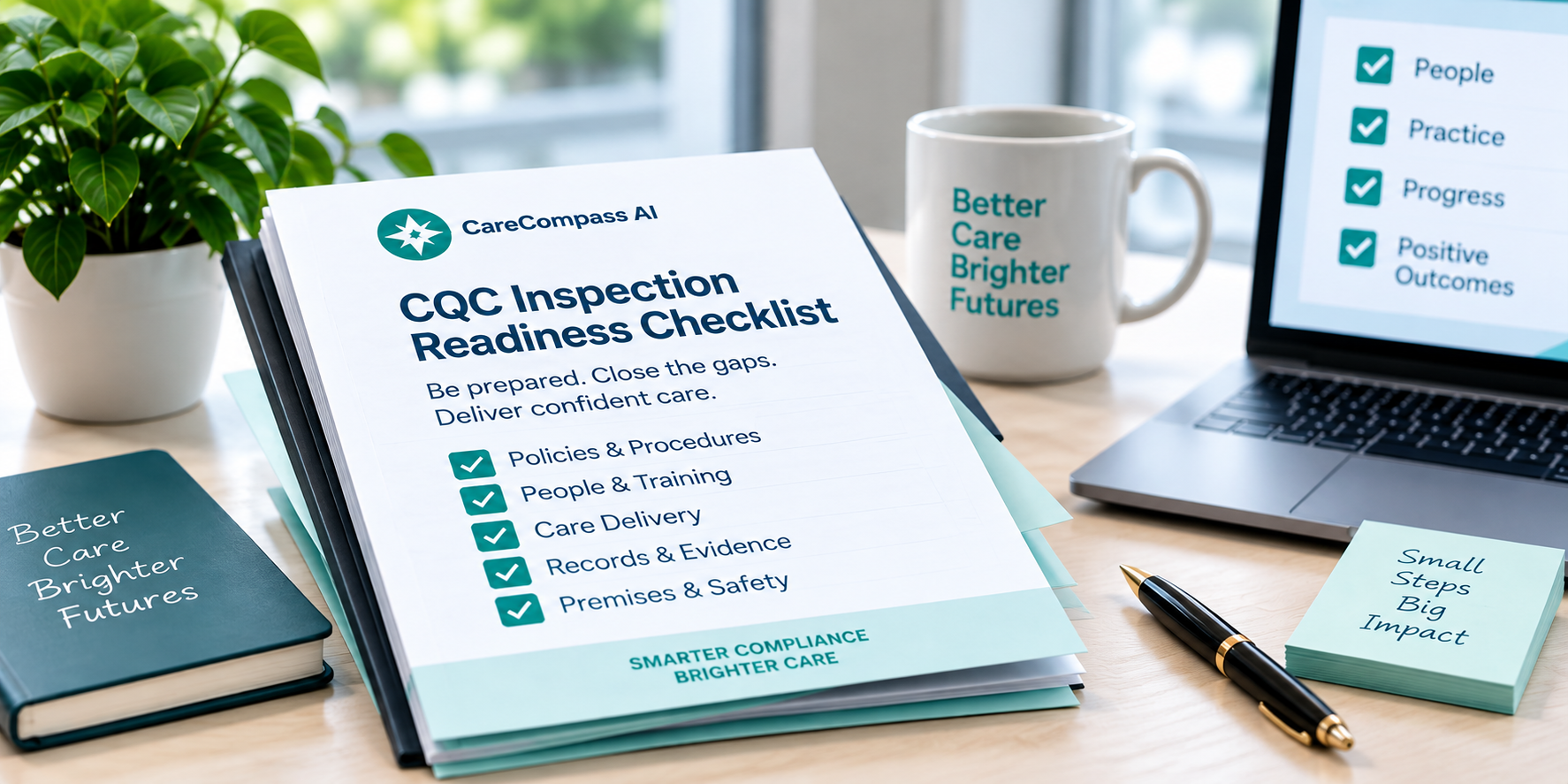
CQC inspection readiness checklist for care providers
CQC READINESS

CQC Inspection Readiness:
What Care Providers Should Review Before an Inspection

Preparing for an inspection shouldn’t mean scrambling through folders at the last minute. A better starting point is knowing what is happening in your service, where the risks are, and whether your evidence reflects the care people actually receive.

◷ 18 min read •  September 2026

CQC inspection readiness checklist for care providers

Inspection readiness starts  before the inspection

If an inspection were announced tomorrow, would your first instinct be to start hunting for documents?

If so, you’re probably not alone. Policies get updated, audits sit in different folders, actions are recorded in different places, and managers are often balancing compliance work with the day-to-day reality of running a care service.

But being inspection-ready isn’t really about producing a perfect folder at short notice.

A more useful question is: can you see what is happening in your service today?

That means understanding where risks are developing, whether actions have actually been completed, what people using the service are experiencing, and whether your records support the picture you believe to be true.

That matters because an inspection is not simply a check of one folder or one set of documents. CQC can gather evidence both on and off site, and what it considers will depend on the service, the areas being assessed and the information it already holds.

So there isn’t one universal pack of documents that every provider can prepare and consider the job done.

Good preparation is therefore less about getting ready for CQC and more about knowing your own service well enough that an inspection doesn’t reveal important things you should already have known.
A SIMPLE WAY TO THINK ABOUT IT

Inspection readiness is not about making everything look perfect. It’s about knowing what’s working, knowing what isn’t, and being able to show what you’re doing about it.

01 — PEOPLE'S EXPERIENCE

Start with what people actually experience

It can be tempting to begin an inspection review with policies, audits, and folders. But another place to start is the experience of the people receiving care.

A service can have well-organised paperwork and still have gaps between what its records say and what people experience day to day.

So before looking for evidence that everything is working, try looking at the service from the other direction: if you were receiving this care, what would you notice?

Are people being listened to? Do they understand what’s happening with their care? Are their preferences reflected in everyday decisions? And when they or their families raise something, can you see what happened next?

These aren’t just useful questions before an inspection. They’re useful questions for understanding whether the service people experience matches the service you believe you’re providing.

WHAT TO LOOK AT

You don’t need to review every record at once. Start with a small sample and look for consistency between what people say, what staff understand and what your records show.

Feedback and concerns

Look at recent compliments, complaints, surveys, and informal feedback. Are the same concerns appearing more than once?


Choice and involvement

Can you see how people are involved in decisions about their care, routines, and preferences?


Changes in people's needs

Where someone’s needs or circumstances have changed, does their care appear to have changed with them?


Actions and follow-through

When someone raises a concern or asks for something to change, is it clear what happened afterwards?

ASK YOURSELF
QUICK CHECK

Pick three people whose care you know reasonably well.
For each person, compare their current care plan, recent notes, feedback, and any changes in needs or preferences.
You’re not trying to prove that everything is perfect. You’re looking for one thing:

Does the story in the records make sense when compared with the person’s actual experience?
If those two pictures don’t quite match, you’ve found something worth understanding before moving on.

02 — RECORDS & EVIDENCE

Check whether your records tell the same story

People’s experiences give you one side of the picture. Your records should help you understand the other.

The question isn’t simply whether records exist. It’s whether someone reading them can understand what is happening with a person’s care now.

Imagine opening one person’s care plan, recent daily notes and risk assessments without already knowing them. Would those records give you a consistent picture of their current needs, preferences and risks?

Or would you find yourself wondering which version is the most up to date?

Small inconsistencies can easily creep in. A person’s needs change, a new risk is identified, staff adapt how they support them — but one part of the record doesn’t quite catch up.

That’s why a useful records review isn’t just about checking whether boxes have been completed. It’s about asking whether the information still makes sense when you read it as one story.

WHAT TO LOOK AT

Choose a small sample of records and follow each person’s information across the places where their care is documented. You’re looking for gaps, contradictions and information that may no longer reflect what is happening today.


Current information

Does the care plan reflect the person’s needs and circumstances today, or are there details that clearly belong to an earlier point in their care?


Changes carried through

If a need, preference or risk has changed, has that change been reflected wherever staff would reasonably need to see it?


Decisions and actions

Where an important decision has been made, can you understand what was decided, why, who was involved and what happened next?


Everyday notes

Do recent notes support the picture described in the care plan, or do they suggest something different is happening in practice?

TRY THE THREAD TEST

Choose one recent change in a person’s care and follow it through the records.

For example, perhaps their mobility has reduced, their medication has changed, they’ve developed a new dietary need, or their preferred routine has changed.

Now follow that change through the relevant records.

Can you trace a clear thread from the change being noticed → to a decision being made → to the care plan being updated → to staff providing the care differently?

If the thread disappears somewhere along the way, that’s a useful place to look more closely.

ASK YOURSELF
QUICK CHECK

Choose three care records you haven’t specifically selected because they’re inspection-ready.

Don’t begin with the records you know best. Pick a small, ordinary sample and read across each person’s recent information.

Look for dates, changes in needs, decisions, risks, and follow-up actions.

Then ask:

If I knew nothing about this person except what is written here, would I understand how to support them today?

If the answer is unclear, don’t just correct the individual entry. Look at why the information became disconnected in the first place.

03 — RISKS & ACTIONS

Look at risks that are still open

Most services know about at least some of their risks. The harder question is what happened after those risks were identified.

A concern may have been discussed in a meeting, added to an action plan or recorded in an audit. But recording a risk isn’t the same as managing it.

What matters is whether someone owns the next step, whether action has actually been taken, and whether you know if that action made a difference.

This is where seemingly small issues can become more significant: not because nobody noticed them, but because they stayed open for too long.

WHAT TO LOOK AT

Start with the risks and actions you already know about. Look across recent audits, incidents, complaints and review actions to see what is still open, what keeps returning and where responsibility may be unclear.

Outstanding actions

Are actions from audits, incidents, complaints or previous reviews still open beyond the date you expected them to be completed?


Repeated concerns

Are the same issues appearing in different places — for example, in complaints, audits, staff feedback or incident reviews?


Unclear ownership

Where action is needed, is it obvious who is responsible for taking it forward and when it should be reviewed?

THE OPEN-ACTION TEST

Choose five actions that are currently marked as outstanding.

For each one, ask three simple questions:

Who owns it?
When is it due?
How will we know when the risk has actually reduced?

If you can’t answer one of those questions easily, the action may be recorded without being actively managed.

And if the same action keeps being moved to a new date, look beyond the deadline. What is preventing it from being resolved?

QUICK CHECK

Look for the oldest unresolved issue you can find.

Don’t focus only on how long it has been open. Ask what has happened during that time.

Has the risk changed? Has temporary action become the normal solution? Has somebody checked whether the original concern still exists?

An old action isn’t automatically a serious problem — but an old action nobody can explain deserves attention.

04 — INCIDENTS & LEARNING

Review incidents for learning, not just completion

You can record, review, and formally close an incident— but that doesn’t necessarily mean the learning is finished.

The more useful question is what changed afterwards.

If similar incidents keep happening, or the same contributing factors recur, it’s worth looking beyond the individual event. There may be a pattern that isn’t obvious when incidents are reviewed separately.

So rather than asking only “Was this incident dealt with?”, also ask: “What did this incident teach us about the service?”

WHAT TO LOOK AT

Start with a small sample of recent incidents and look beyond whether the forms were completed. Pay attention to what happened afterwards, whether similar issues have appeared elsewhere, and whether the actions taken made a noticeable difference.

Repeated patterns

Are similar incidents happening more than once, even if each one has been individually reviewed and closed?


What changed afterwards

Where learning or improvement was identified, can you see what changed in practice as a result?


Whether the change worked

Has anyone gone back later to check whether the action taken actually reduced the concern or prevented it from recurring?

LOOK BEYOND THE INCIDENT COUNT

Choose one type of incident that has happened more than once.

Put the individual reports to one side for a moment and look at them together.

What do these incidents have in common?

Look at when and where they happened, who was involved, what was happening beforehand and whether the same contributing factors appear more than once.

Then look at what changed after the earlier incidents.

Did something genuinely change — or did the service mainly become better at recording the same problem?

You may find there isn’t a wider pattern. That’s useful too. The point is to check rather than assume.

The aim isn’t to eliminate every incident. It’s to make sure incidents that do happen help you understand where care could become safer or better.

Further reading: CQC — Learning culture →

05 — STAFF & PRACTICE

Check that staff knowledge matches your paperwork

A care plan can be accurate, a policy can be up to date, and an action can be clearly recorded. But none of that helps much if the people delivering care don’t know what has changed.

Staff don’t need to memorise every document. They do need to understand the things that matter when supporting someone: their current needs, important risks, preferences and any recent changes.

That’s why inspection readiness shouldn’t stop at checking whether information exists. It should also ask whether the right information has reached the people who need to use it.

One of the simplest ways to explore this is to compare what is written down with what staff understand about the care they provide.

WHAT TO LOOK AT

Choose a few areas where staff need current information to provide safe, consistent care. Then compare what the records say with what staff understand and what appears to happen in practice.

Recent changes

If someone’s needs, risks or preferences have changed recently, do the staff supporting them know what is different?


Consistent understanding

If you asked two staff members about an important aspect of someone’s care, would their answers broadly match each other and the current care plan?


Handover into practice

When important information is shared through a handover, meeting or update, can you see that it has reached the people who need to act on it?

THE PAPER-TO-PRACTICE CHECK

Choose one person whose care has changed recently.

Read the current information first. Then, without asking staff to look at the records, have a normal conversation with someone who regularly supports that person.

You aren’t testing whether they can recite the care plan.

You’re looking for something more useful:

Do they understand what matters today, what has changed and what they need to do differently?

If the written information and staff understanding don’t match, look at where the communication may have broken down.


A strong record tells you what should happen. Staff understanding helps you see whether that information has made it into everyday care.

06 — AUDITS & IMPROVEMENT

Review your audits — and what happened afterwards

Audits can tell you a lot about a service — but only if something happens with what they find.

It’s possible to have a well-organised audit schedule, completed forms and action plans, while the same issues continue appearing month after month.

So don’t stop at asking whether an audit was completed. Look at what it uncovered, what happened next and whether anyone checked that the improvement actually lasted.

A completed audit shows that something was reviewed. The real value is in what the service learned and improved because of it.

WHAT TO LOOK AT

Choose a few recent audits from different areas of the service. Rather than focusing on whether every box was completed, follow the findings through to the actions, changes and later reviews.

What the audit found

Does the audit clearly show where something needed attention, rather than simply recording that the review took place?


What happened next

Where an issue was identified, can you see who took action, what changed and whether it was completed?


Whether improvement lasted

Was the area reviewed again later to see whether the change worked — or has the same issue appeared again?

FOLLOW ONE FINDING

Choose one recent audit that identified an area for improvement.

Start with the finding and follow it forward.

What action was agreed?
Who took responsibility?
What actually changed?
Was it checked again afterwards?

Don’t worry if the improvement wasn’t immediate. Some changes take time.

What you’re looking for is a clear connection between something being identified, action being taken, and someone checking whether that action made a difference.

If that trail disappears halfway through, that’s where to look more closely.

An audit is most useful when it closes the loop: identify something, act on it, and check whether things improved.

ONE QUESTION THAT BRINGS IT ALL TOGETHER

If someone asked me today where the biggest quality risk in this service is, could I answer confidently?

After reviewing people’s experiences, records, open risks, incidents, staff knowledge and audits, you should start to see a clearer picture of the service as a whole.

You may find several things that need attention. That’s normal. The important part is being able to distinguish between routine improvements and the issues that could have the greatest impact on people’s care.

So bring everything you’ve reviewed back to one question:

If someone asked me today where the biggest quality risk in this service is, could I answer confidently?

Being able to answer doesn’t mean having every problem solved. It means knowing where attention is needed, what is already being done and what needs to happen next.

A simple pre-inspection review

You don’t need to review everything at once to get a useful picture of your service.

Start small. Choose a few recent examples, follow them properly and pay attention to where the information stops making sense.

The six checks below bring together the areas we’ve covered and can help you decide where a closer look may be needed.

01 — LISTEN

Start with people's experience

Choose a small sample of people and compare what they or their relatives are telling you with what your records suggest is happening.


02 — TRACE

Follow one recent change

Take a change in someone’s needs, risks or preferences and follow it through the care plan, recent notes and the information staff are using.


03 — FOLLOW UP

Find an action that's still open

Choose an outstanding action and check who owns it, what has happened so far and how you’ll know when the underlying risk has reduced.


04 — LEARN

Look across recent incidents

Take one type of incident that has happened more than once and check for common factors, previous actions and evidence that something changed afterwards.


05 — ASK

Compare paperwork with staff understanding

Choose one person whose care has changed recently and check whether the staff supporting them understand what matters now.


06 — CLOSE THE LOOP

Follow one audit finding

Start with something a recent audit identified and trace it through the action taken to the later check that tells you whether things improved.

WHEN YOU'VE FINISHED

Step back from the individual checks and look at what they tell you together.

Which issue needs your attention first?

You may have found several gaps. Don’t try to make everything look perfect at once. Prioritise what could have the greatest effect on people’s care, make the next action clear and decide when you’ll review it again.

The aim is to leave the review with a clearer picture of your service — not simply a longer list of tasks.

What to do if you find gaps

Finding a gap during your review doesn’t necessarily mean something has gone badly wrong.

It means you’ve found something you can understand and act on before it becomes harder to manage.

The temptation is to create a long action list and try to fix everything at once. A more useful approach is to decide what matters most, make responsibility clear and check that the action actually made a difference.

START WITH WHAT MATTERS MOST

01 — PRIORITISE

Deal with the greatest potential impact first

Ask which gaps could have the biggest effect on people’s safety, wellbeing or quality of care. Those should normally receive attention before lower-impact administrative issues.


02 — MAKE THE NEXT ACTION CLEAR

Give each priority an owner and a next step

Be specific about what needs to happen, who is responsible and when it should be reviewed. Avoid actions so broad that nobody is quite sure when they’re complete.


03 — GO BACK AND CHECK

Don't assume that completing the action solved the problem

Return to the issue afterwards. Has practice changed? Has the risk reduced? Is the improvement showing up in people’s experience, records or other evidence?


DON'T JUST FIX THE EXAMPLE

If you find one outdated care plan, one overdue action or one member of staff who missed an important update, correcting that individual example may only solve part of the problem.

Ask one more question:

Why did this gap happen in the first place?

Sometimes the answer will be a one-off mistake. Other times it may point to something wider — how information is shared, how actions are followed up or how changes are checked.

Understanding the reason helps you improve the system rather than repeatedly correcting the same symptom.

The goal isn’t to remove every imperfection before an inspection. It’s to know where your risks are, take proportionate action and be able to show what you’re doing to improve.

Note: This guide is intended as practical information for care providers and isn’t a substitute for CQC guidance or professional advice. Always check current CQC guidance when reviewing regulatory requirements.

FREE CARE QUALITY RISK AUDIT

Not sure where your biggest risks are?

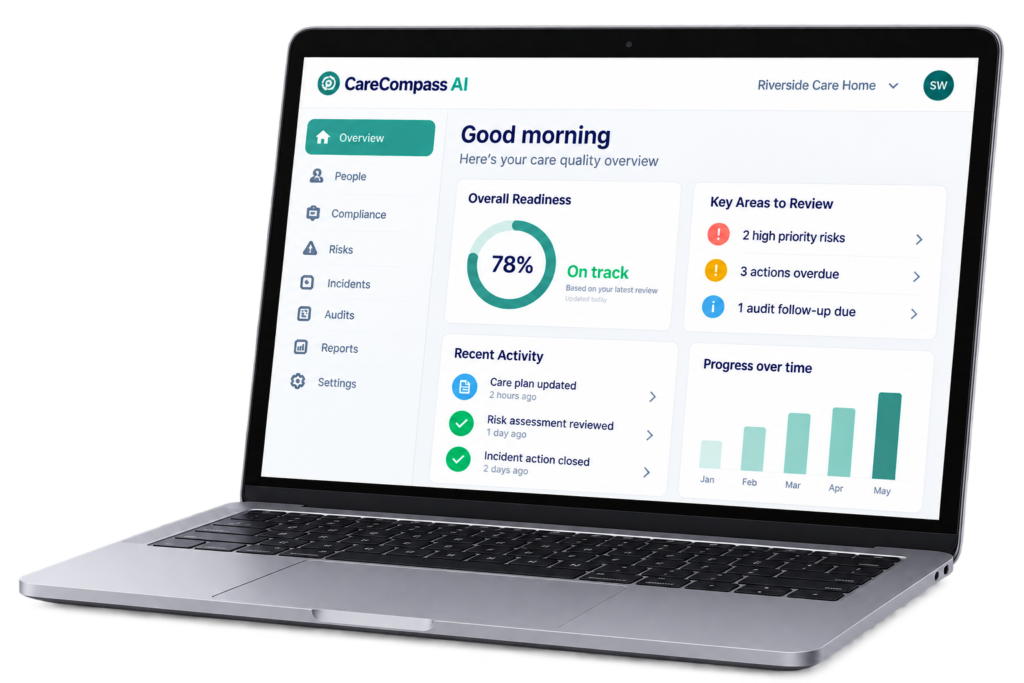
You don’t have to work it all out from scratch. The free CareCompass AI Care Quality Risk Audit helps you take a structured look at your service and identify areas that may need closer attention.

Leave a Reply

Your email address will not be published. Required fields are marked *